
The internet may feel like something intangible, but it runs on very real infrastructure. Servers run 24/7, data travels across global networks, and devices constantly process information. All of this consumes electricity, and depending on the energy source, that electricity can produce carbon emissions.
According to the World Bank, the internet accounts for an estimated 2-4% of global carbon emissions (similar to the airline industry). When a website is loaded with large/unoptimized images, videos, and complex scripts, it requires more data transfer and processing power, increasing energy use.
Maintaining a carbon-efficient website (one that uses less energy when people visit it) has a real environmental impact. Every page view uses electricity through data centers, networks, and user devices. But carbon efficiency doesn’t just benefit the environment – an efficient website is also faster, better performing, and more secure.
At Barrel Roll, we help businesses reduce their website’s footprint through professional WordPress optimization services that improve performance, reduce energy usage, and create more sustainable websites.
Wondering what your website’s carbon footprint is?
You can visit the website https://www.websitecarbon.com/ to get an estimate and see how your site is ranking compared to the global average.
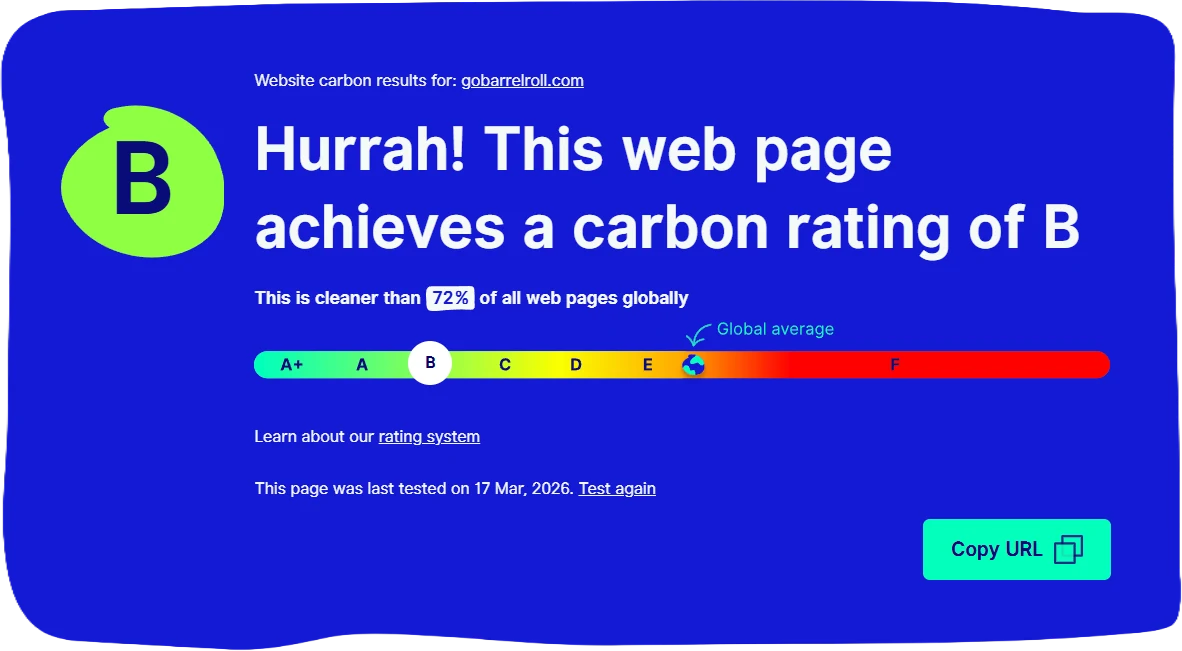
The website you’re visiting now (hi, we’re Barrel Roll 👋) is cleaner than 72% worldwide, and our members have carbon-efficient websites as well – over 80% of our members are as or more carbon efficient than the global average.
We regularly monitor our members’ websites to make sure they keep up with, or exceed, rising efficiency standards.
The business benefits of reducing your website’s carbon footprint
Sustainability is no longer just a way for businesses to market themselves. It also helps them stay ahead of the competition. Reducing your carbon footprint helps your business lower costs, improve website performance and build a stronger reputation.
Supporting CSR and ESG Reporting Goals
Enhancing the carbon efficiency of your website can also help with Environmental, Social, and Governance (ESG) reporting and Corporate Social Responsibility (CSR) programs. Websites and other digital operations are being incorporated into emissions-tracking systems as more businesses assess their environmental impact.
Scope 3 emissions, which include indirect emissions from business operations, usually include emissions from websites. Even though a single website might not have much impact, monitoring and improving it demonstrates a measurable commitment to sustainability and ethical business practices.
Better SEO & Website Performance
Reducing digital carbon emissions can improve your website’s performance. Better load times, cleaner code, and optimized hosting all improve the user experience, which helps search rankings, lowers bounce rates, and boosts conversions.
Google prioritizes fast, efficient websites, so making your site more carbon-efficient can also boost your SEO.
Preparing Your Business for What’s Next
For many companies, sustainability is a necessary component of operating responsibly. Reducing the carbon footprint of your website is an easy, achievable step you can take now rather than deal with more significant changes later.
Differentiating Your Website from the Competition
Combined with performance improvements and communication about your efforts, a more sustainable website can help position your business as thoughtful, responsible, and forward-thinking while supporting your broader business goals.
Our approach to carbon-efficient WordPress optimization
Performance optimization is one of the first steps we take when working with our members. We reduce the processing power required per visit by optimizing how your website loads and displays content, but before we make any updates, we record a snapshot of our new members’ websites as they currently exist and use that as a benchmark for progress.
%
Our Members At or Lower Than Global Average of Carbon Usage
%
Our Members Hosted on Green Servers
Performance Optimization
We improve page load speed by reducing unnecessary code, improving caching, and more, so browsers don’t have to work as hard to load your website.
Ongoing Maintenance
A website is never truly “done.” Every time you add a new image, update a plugin, or install a third-party tool, it could chip away at efficiency unless the website is routinely optimized.
Image and Media Optimization
Compressing and properly sizing images means your site transfers less data without sacrificing quality. Media is often a major contributor to slow speeds, and several of the websites we maintain have benefited from load-time reductions of over 40% from image optimization alone.
Plugin Cleanup
Accumulating too many plugins floods browsers with separate CSS and JavaScript files, which jams up requests and delays page rendering. We remove unnecessary plugins and replace inefficient ones to reduce processing time.
Guidance on Hosting Efficiency
Websites need a reliable host to fully benefit from optimization. Hosting on older servers running outdated software will hold back your website speed (which, in turn, affects your SEO performance). We also recommend that all of our members host their sites on sustainable servers powered by renewable energy.
Great for the planet, great for business
Sustainability and high performance are two sides of the same coin. A faster, more sustainable website is better for your users, better for your bottom line, and better for the planet. If you’re ready to see how efficient your website can be, get in touch with us for a complimentary, no-pressure review of your website.